When airlines start hiring again, I know who will get hired first. They won’t be the cadets. The global pilot shortage is real, but hiring happens locally, and it follows a pattern I’ve watched repeat for twenty years.
In the summer of 2026 the headlines said record flights all over Europe. The world had never seen as many airliners in the air at once, and airlines reported record capacity and record passenger numbers.
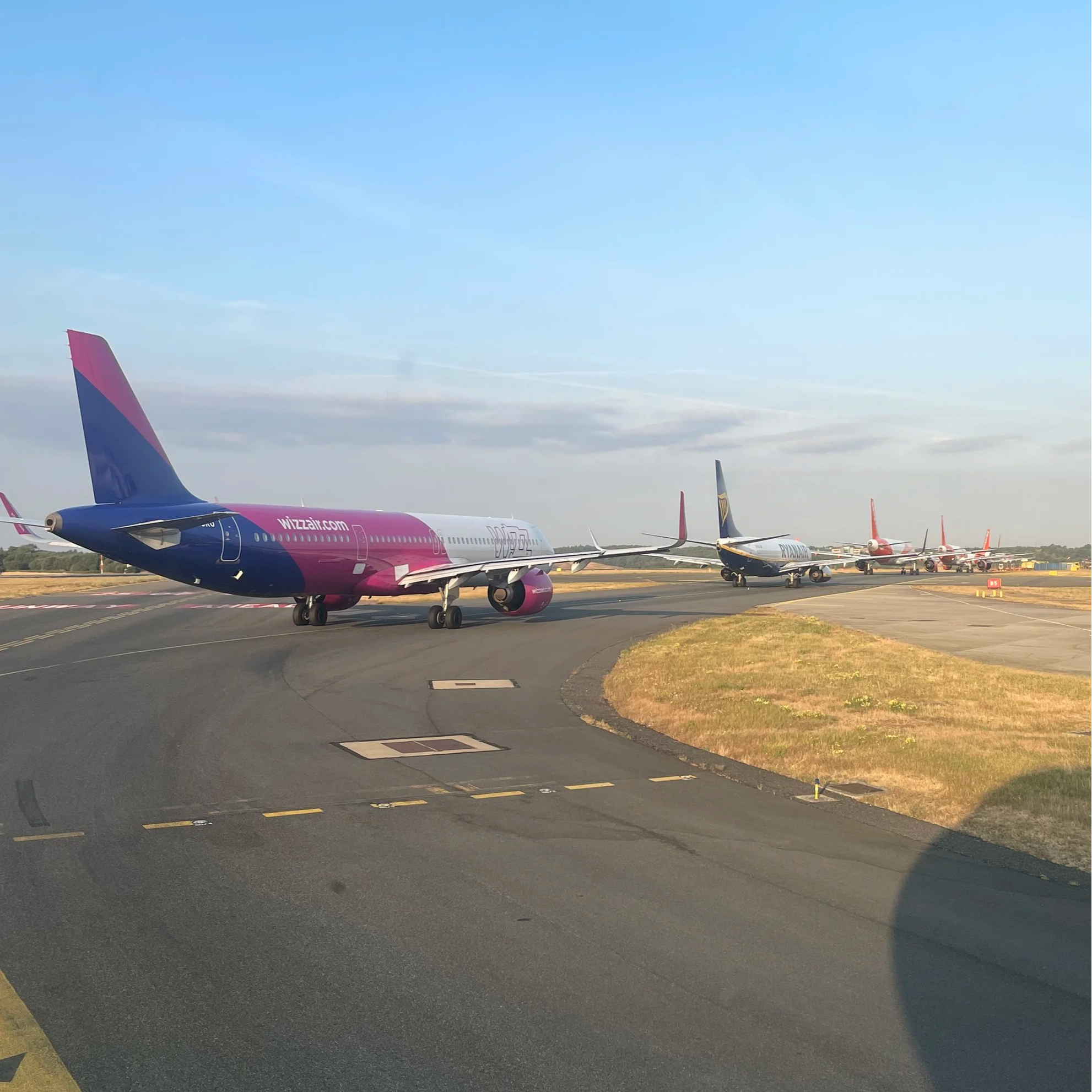
A common sight.
My observation on the line was so different from these reports that it started to bug me. It had already started in the winter and spring. Everything felt slower. The airport was a lot less busy than it used to be, even though our loads were good. Several aircraft sat idle on the ramp on any given day, which was previously unheard of. Training was being cut back, at ours and at other airlines, and cadet hiring virtually stopped.
If you are a cadet in a year like that, you finish your training, send your applications and hear nothing back. Following the busiest summer season in history. In a global pilot shortage. You start wondering what you are doing wrong.
Most of the time you are not doing anything wrong. It's the industry, and it moves in a pattern I've watched repeat for twenty years. To see it, you first need to understand how the first officer seats you are aiming for actually open up, and who else is queuing for them.
How first officer seats open up
I don't think it's a big stretch to assume that most cadets looking to get hired in Europe and the UK are looking at the low-cost carriers: Ryanair, Wizz Air and easyJet. These are the big three players, each with a fleet well above 200 aircraft. The smaller carriers don't reflect what the industry is doing as well as these three do.
Four things decide how many first officer seats open up at these airlines:
Fleet growth. If an airline adds airframes, it needs more first officers. Simple as that.
Captain upgrades. They depend on fleet growth, but they also happen on their own when captains retire or leave the company. Every upgrade frees a right seat.
Retirements. Most retirees are captains, so retirements feed straight into upgrades.
First officers leaving. Low-cost first officers leave in big numbers for wide-body flying, for the legacy carriers or for expat jobs in the Middle East and Asia. More money, prestige, lifestyle or a sense of adventure. Every one of them leaves a seat behind.
When all four are moving, seats open up fast. When they stall, the bottom of the ladder freezes.
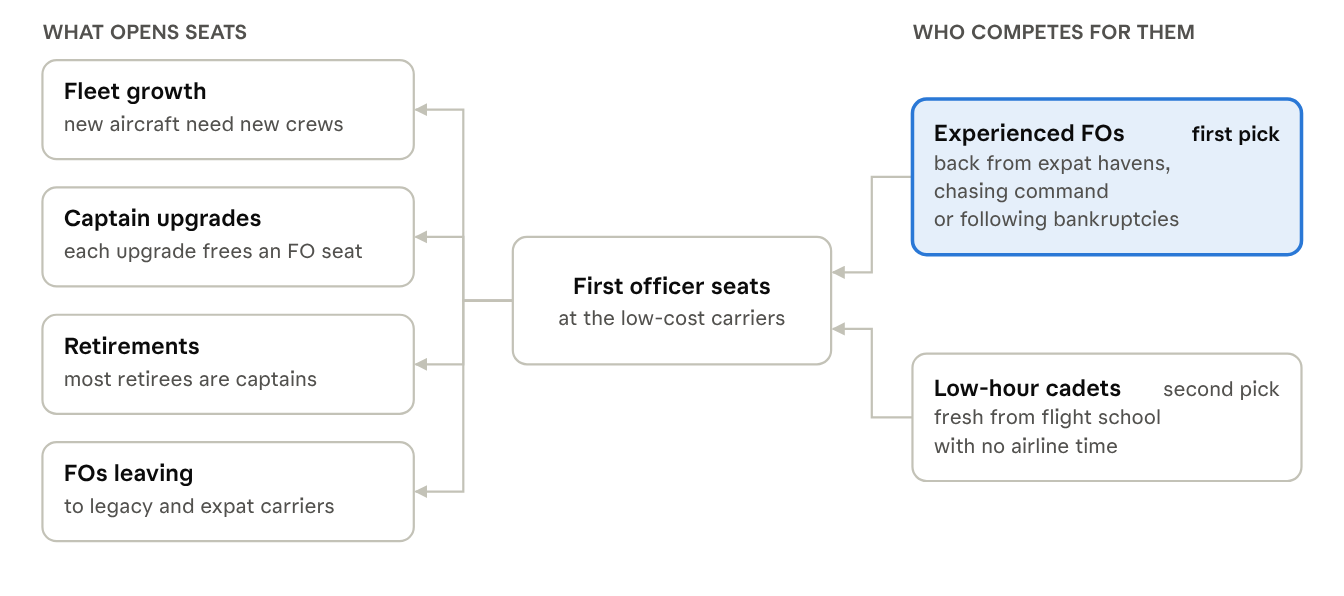
Simplified headcount mechanism for bigger low cost carriers
Who you are competing with
Two groups compete for those seats. You, the low-hour pilots finishing flight school. And the experienced first officers.
The experienced first officers come from several places. Wide-body and expat pilots who got tired of the Middle East or Asia and want to come back to Europe. Pilots at legacy carriers chasing a command, where the waitlist is usually 10 to 15 years, and let's be honest, it gets a little bit old sitting in the right seat. And crews freed up when a weaker operator folds.
Airlines hire from the experienced group first. A pilot with airline experience can be trained on type within two to three months. A cadet takes about six months of onboarding and serious money to train. An experienced pilot requires less training, fewer resources, but more importantly, carries less risk. Somebody already trained them and placed their trust in them for several years. With a cadet it's all questions. Will they be motivated? Will they show up? Will they pass the training? Do they have what it takes?
So as the experienced group grows, your chances of getting into one of those seats shrink.
Record capacity and no hiring: what happened in 2026
On a global scale there is a pilot shortage. Nobody is denying that. Look at the fleet growth of airlines worldwide and the shortage is massive. On a regional scale, though, there are wide variations. In the early 2000s and 2010s, Asia was booming like nobody's business while Europe grew at a much less exciting pace. There can be a global pilot shortage without a local one, and that is what we are seeing in Europe now.
The timing matters. Airlines hire strategically about six months in advance, so the hiring for summer 2026 was done in the winter of 2025. They looked at the outlook and the booked tickets, and they hired for that.
The plot thickens
Then came the war against Iran and the blockade of the Strait of Hormuz. Jet fuel prices rocketed, and the travelling public no longer felt safe flying towards the Middle East. Airlines had to redistribute capacity straight away, and moving aircraft from a mature city pair that makes money to an unproven route is expensive. It takes time before a new route starts paying.
The second problem was fuel. When fuel prices double, airlines normally pass the surcharge on to the passengers. This time that didn't work. Europe already has structural issues, like a higher cost of living than a few years ago, and the travelling mood shifted. People were more reluctant to spend money on travel and to plan their summer ahead. Compared to previous years, the bookings just didn't come.
To fill their capacity, airlines lowered fares to a point where Europeans would be willing to travel. That is how you get record passenger numbers and almost no hiring in the same summer. Both things can be true at once.
As the airlines started planning for 2027, they have slashed their growth forecasts. Fewer flights, a lot of consolidation between airlines, and fewer opportunities for first officers.
How to estimate the seats yourself
You can work out the available first officer seats for any year from publicly available data such as aircraft orders. Take the new airframes, multiply by six first officers, then add the right seats freed by internal upgrades for the new captain seats. Here is how it looked for the big three going into 2027. It's a speculation and open to changing micro and macro economic conditions.
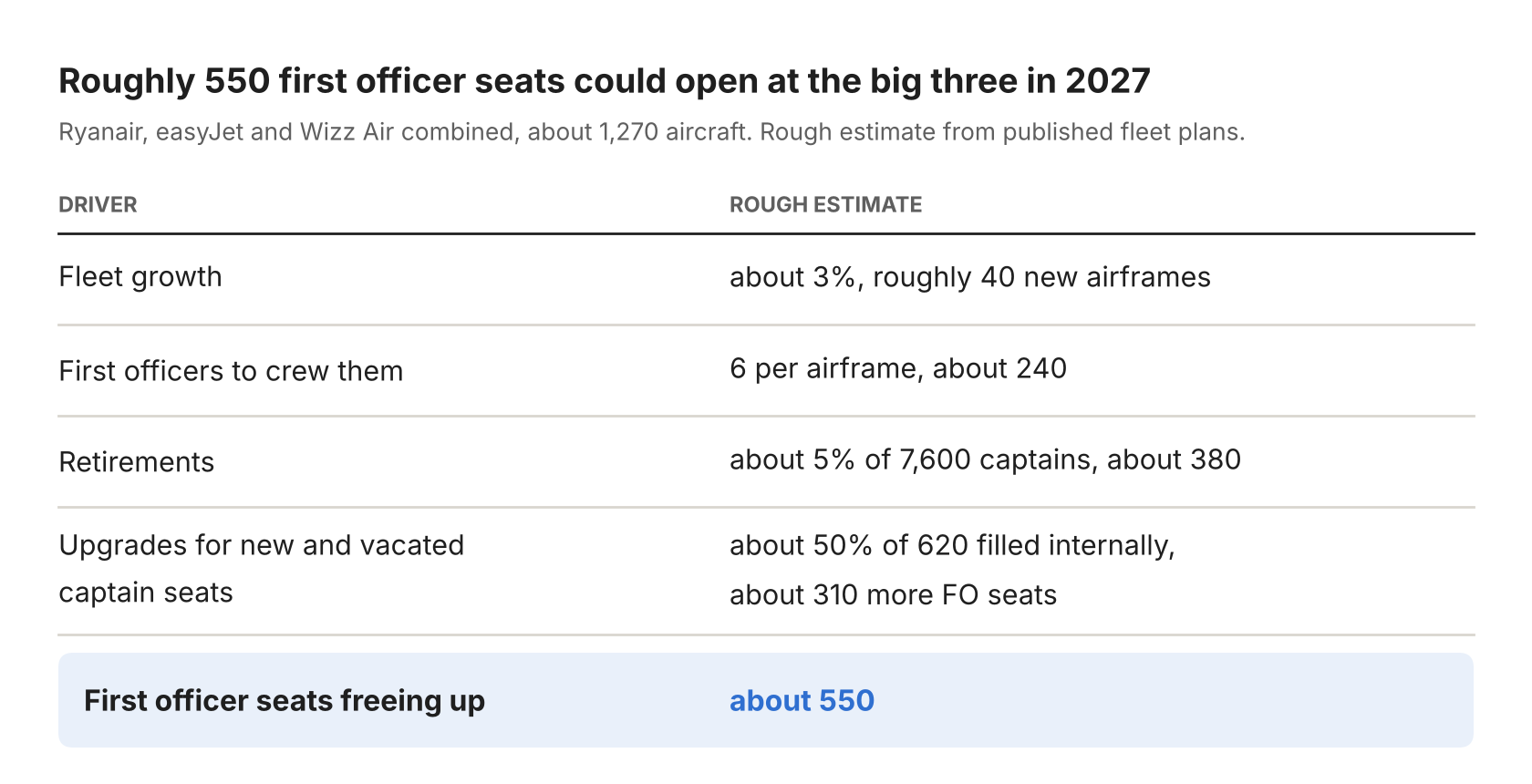
Why were only about half the commands filled internally? After COVID there was a massive boom in cadet hiring, some of them hired before they even finished flight school. Many of them still didn't have the hours for a command upgrade.
Then check the drivers that normally pull experienced first officers out of the low-cost carriers. Going into 2027, they had all stalled:
The Middle East. The Gulf carriers needed pilots so badly it's unbelievable, but in 2026 they weren't attractive, for obvious reasons. If you have a war going on next to you, people are reluctant to go. I met quite a few pilots who were interested in joining a Middle East airline and held back for exactly this reason. Nobody likes uncertainty.
The legacy carriers. They were all slashing their outlook for the next few years. If there are no seats available, not many people leave for them.
Consolidation. In difficult times, with high fuel prices and overcapacity on the market, operators with weaker balance sheets tend to go bankrupt. That frees up experienced pilots, who then compete for the same seats as you.
Finally, watch for shocks in the regions that absorb experienced crews. In 2026 the main Gulf carriers employed roughly 10,000 pilots, around eight in ten of them expats, and somewhere between 4,000 and 5,000 of those were British or European. If airspace closures or economic restrictions lead to a prolonged capacity reduction, those carriers are known to cull their workforces aggressively. Thousands of experienced, type-rated crews could then come back to the UK and Europe looking for work.
Put those together and you can see why the outlook for 2027 looked a bit gloomy. Run the same check in any year and you'll know roughly where you stand.
Hiring will come back. It always does.
When airlines start hiring again, I know who will get hired first. They won't be the cadets.
When we started hiring after COVID, our assessment slots filled up overnight with type-rated captains and experienced first officers. We chose between good and better: the most hours, the most experience. The cadets never got invited, because there was always someone with thousands of jet hours and a type rating in the CV pile.
Airlines either hire hundreds of pilots or none at all. There is no in between, and because the same economic factors hit everyone at once, they all do it at the same time. Only when they run out of experienced people do they turn to cadets. That could be six months or two years.
Even in the best case it takes time. Imagine the war stops, fuel prices return to normal and the war in Ukraine ends, which would be amazing. Airlines still need to adjust their capacity first, and there is usually a lag of around six months before low-hour hiring resumes at the bottom.
The one exception is tactical hiring. Airlines always need captains and experienced first officers to fill a couple of seats when someone retires, falls ill or leaves. Those seats go to experienced pilots, because they are easier and faster to train.
The entry requirements you see on hiring websites today are man-made. They aren't set in stone. In 2024 and 2025 you didn't see a requirement for 500 hours on CS-25 aircraft anywhere. I recently looked at a Middle East carrier asking for 2,000 hours for a first officer position, and I remember a time when they were happy with 1,000. When hiring picks up, the bar comes down: 500 hours, then 300, then 200. Maybe not as explicitly as it is listed, but that is how airlines start pulling people in. If you want to know what the industry is doing right now, look at the requirements on any airline's hiring website.
Is it you or the industry?
If the invitations aren't coming, it's not your fault. In 2024 we were so short of pilots that we looked at flight schools and hired cadets before they had even finished their training. In the UK, if somebody had a pulse and a pilot's licence, we would invite them for an assessment, and we were not the only operator doing it. That changed in a matter of months. Nothing about you has changed.
Europe is more difficult than the UK at the moment, but I'm seeing signs that the UK will follow. Post-Brexit, the UK is a closed market. When the hiring is good, it’s a proper hiring frenzy, because the competition stays small. When the hiring is not so good, there's no way out.
What will hiring look like in two years? I have no idea, and anybody who says they know is not telling you the truth. The global shortage is very real, but in a constrained market like Europe, or the even more constrained UK, so many small factors can move the numbers that a forecast is impossible.
What I do know is that this industry is cyclical. I've seen it after 9/11, in 2008, in 2012, and through COVID. It always comes back with a vengeance. People like to call these events black swans, but in aviation they tend to happen every two years, so I've started to doubt whether they are black swans at all. When the market comes back, the experienced pilots go first, and the most prepared cadets go next.
So what can you do about it?
The market decides when airlines hire. You don't. But whether you're ready when the hiring comes, that's entirely your responsibility.
If you qualify into a downturn, you have a choice, and it's the choice that decides everything. You can wait. Or you can keep flying.
Read next: Stop Being A Cadet